bagasse pulp
Learn More


 11:22
11:22 Choosing the wrong paper for a high-page-count book can create a thick spine, poor readability, heavy shipping weight, and visible print from the reverse side. For publishers and printers, the answer is Bible paper—a lightweight, high-opacity specialty paper designed for dense text, compact books, and professional printing.
Bible paper is a very thin, lightweight printing paper used for Bibles, dictionaries, reference books, manuals, and other publications with many pages. It combines low GSM, controlled thickness, good opacity, smoothness, strength, and printability, helping publishers reduce book bulk while keeping text clear and readable.
Bible paper is a specialized type of paper developed for books that contain a very large amount of text. A Christian Bible, Holy Bible, dictionary, Bible study guide, technical reference book, or legal publication may contain hundreds or even thousands of pages. If normal printing paper is used, the finished book can become too thick and difficult to handle.
The main purpose of Bible paper is to reduce bulk without sacrificing usability. It is made to be incredibly thin, yet it must still provide enough opacity, strength, smoothness, and dimensional stability for professional printing and binding.
This is why Bible paper is often used for:
For B2B buyers, Bible paper is not simply “thin paper.” It is a specialized paper that must balance several performance factors at the same time.
At Sheeon Pulp, we recommend that buyers focus on measurable specifications such as GSM, thickness, opacity, brightness, surface smoothness, reel or sheet size, printing method, and final book application.
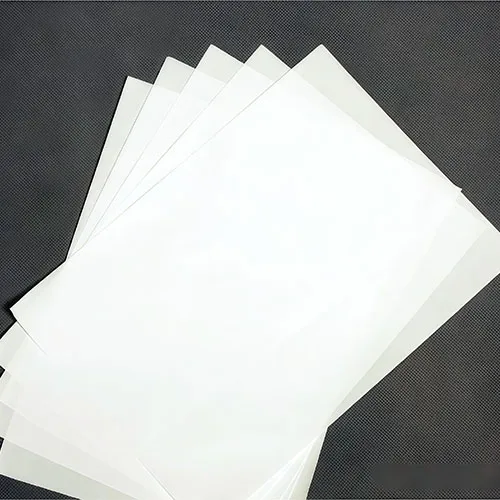
Many buyers first ask: Why is Bible paper so thin?
The answer is simple. A Bible may contain more than 1,000 pages. Even a small increase in the thickness of each sheet can make the finished book much thicker.
By using lightweight paper with a low caliper, publishers can keep the finished book compact and easy to carry.
However, making the paper to be thin creates another challenge. If the sheet becomes too transparent, text printed on the reverse side can be visible. This reduces readability and creates visual distraction.
This effect is often described as show-through.
High-quality Bible paper therefore needs to achieve a careful balance:
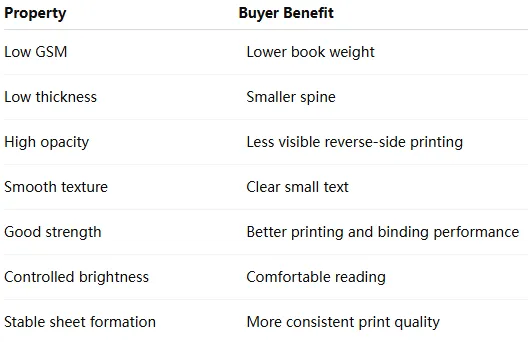
The real value of Bible paper lies in being thin yet functional.
Despite its thinness, a well-designed grade can still perform reliably during printing, folding, binding, and long-term reading.
The performance of Bible paper starts with its fiber structure.
Most commercial grades use carefully selected pulp that can produce a thin, uniform, smooth sheet. Depending on the specification, the furnish may include refined cellulose fibers and selected fillers or pigments that improve printing and optical performance.
The fiber source, refining process, filler system, sizing, pressing, and surface treatment all influence the final properties of the paper.
Some lightweight papers may use high-purity wood pulp, while other specialty papers may use alternative fiber systems depending on the manufacturer and application.
One important concern is opacity.
Because the paper is so thin, manufacturers may use mineral fillers or pigments to improve light scattering. Titanium dioxide is one well-known white pigment that may be used in papermaking because of its high refractive index.
In suitable formulations, titanium dioxide is added because it can be added to increase opacity.
This does not mean every Bible paper uses the same formula. Buyers should always confirm:
The goal is not simply to create a white sheet. The goal is to create a thin sheet that remains readable when both sides are printed.
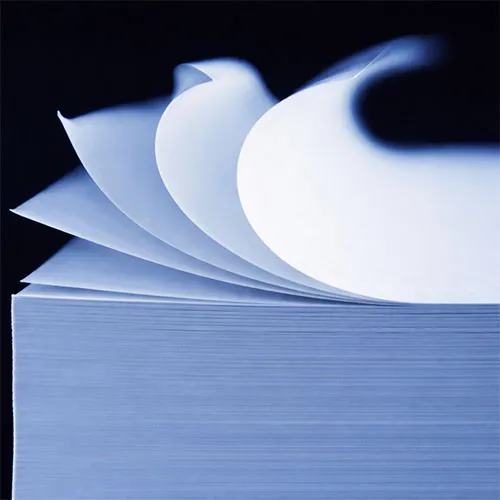
Opacity is one of the most important technical properties in Bible printing.
It describes how well the sheet blocks light and prevents printing or background objects from being visible through the paper.
In simple terms:
Higher opacity = less visible content from the opposite side of the page.
This becomes especially important in Bible printing because most Bible pages are printed on both sides.
If opacity is too low, text on one side can interfere with text on the other. This reduces the reading experience, especially when small fonts and dense paragraphs are used.
Professional paper opacity can be measured using standardized test methods such as those defined by ISO.
For Bible publishers, it is often better to think about opacity together with GSM.
A very high-opacity paper may be easy to produce at a heavier weight. The real technical challenge is achieving high opacity at low GSM.
That is where high-quality Bible paper becomes valuable.
Lower GSM
↓
Lower book bulk
↓
Greater risk of transparency
↓
Need better opacity control
This is also why buyers should not compare Bible paper only by price.
A low-cost grade may look acceptable in an unprinted sample but perform very differently after double-sided printing.
GSM means grams per square meter.
It measures the mass of paper, not its exact physical thickness.
For example, a 40 GSM paper weighs 40 grams per square meter. But two papers with the same GSM can still have different thickness because fiber density, fillers, pressing, and finishing methods differ.
This is why a specification such as 40 GSM Bible paper should not be evaluated using GSM alone.
A B2B buyer should also review:
Depending on the publication, Bible paper may be supplied in different lightweight ranges.
Lower GSM may be preferred when:
Slightly higher GSM may be preferred when:
For this reason, Sheeon Pulp recommends matching the paper grade to the finished product instead of selecting GSM in isolation.

A Bible paper vs normal printing paper comparison shows why Bible paper is considered a specialty grade.
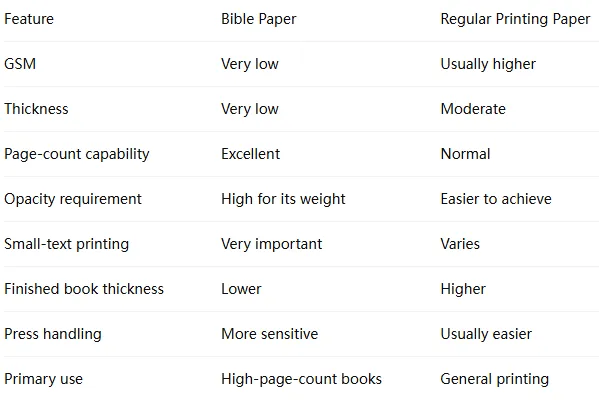
Normal book paper works well for novels, catalogs, textbooks, brochures, and many everyday applications.
Bible paper is used when the publisher needs to fit a large amount of text into a compact book.
It may also be compared with lightweight offset paper, opaque printing paper, dictionary paper, or India paper. These names can overlap in the market, but they do not always describe exactly the same product.
That is why technical specifications matter more than product names.
When evaluating Bible paper vs standard paper, buyers should ask:
These questions lead to a much better material decision.
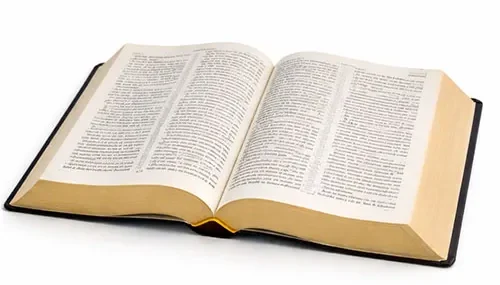
The phrase types of Bible paper can refer to different GSM levels, finishes, opacity levels, fiber systems, or intended applications.
For most B2B buyers, the easiest way to classify the material is by end use.
Compact Bible paper
Used when the publisher wants the smallest possible spine and lowest book weight.
Key priorities include:
A Bible study guide or annotated edition may include additional notes, references, charts, or commentary.
These projects may need:
Better handling strength
A dictionary can contain a very large number of pages with small fonts.
The paper usually needs:
This can be used for technical books, legal materials, manuals, or other publications where page count is high.
Journaling-related paper
Bible journaling may involve materials such as:
These materials may be added to a paper Bible for decoration or note-taking, but they are different from industrial Bible printing paper.
A paper junk journal may also use some of these materials, but it has a different purpose from high-volume Bible publishing.
The surface of Bible paper has a major impact on print quality.
Because many Bibles use small fonts and dense layouts, even small surface defects can affect clarity.
A smoother surface can help create:
However, surface smoothness must be balanced with ink absorption and drying behavior.
If the paper absorbs too much ink, text may lose sharpness.
If ink stays too much on the surface, drying may become more difficult.
This is why Bible printing should be evaluated as a complete system involving:
A useful press trial should test the paper on both sides.
A sheet that looks acceptable when printed on one side may behave differently in full production.
Before a large order, buyers should evaluate:
This is especially important for large commercial printing projects.
The main advantages of Bible paper come from its ability to combine low bulk with high information density.
A well-designed grade helps publishers produce books that are:
For books like Bibles, this can significantly improve the final product.
Imagine a publication with 1,500 pages.
If the paper is too thick, the book may become bulky and difficult to bind.
If the paper is too thin but lacks opacity, reverse-side text may become distracting.
The ideal paper must balance both problems.
Reduced book thickness
A lower-caliper sheet helps control spine size.
Lower transport weight
This can matter in large publishing and export projects.
Good readability
Proper opacity and surface quality support clear small text.
Better portability
A thinner book is more easy to carry.
More design flexibility
Publishers can include more content without making the book excessively large.
Suitable for high-page-count publishing
Bible paper also works well for dictionaries, reference books, and other dense publications.
Searching for Bible paper suppliers, Bible paper manufacturers, Bible paper for sale, or “where to buy Bible paper” produces many possible sources.
But B2B buyers should compare more than price.
A reliable supplier should be able to discuss the application, not just provide a GSM number.
Bible paper supplier checklist
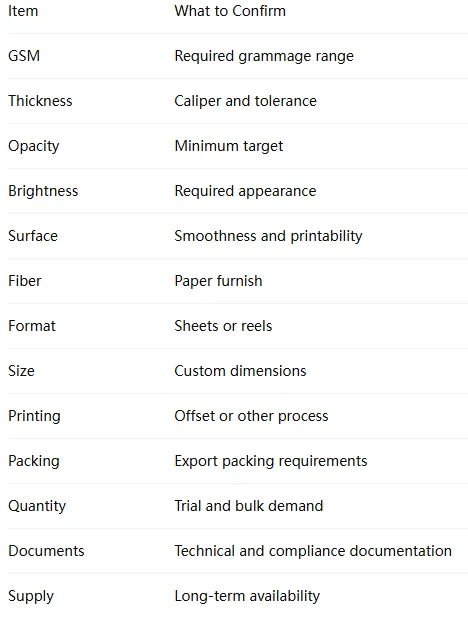
At Sheeon Pulp, we encourage buyers to send a complete technical brief before requesting a final quotation.
Useful information includes:
This allows us to evaluate the application more accurately.

Sheeon Pulp is a China-based B2B supplier focused on eco-friendly pulp and specialty paper materials.
Our product and material portfolio includes:
For Bible paper projects, our focus is on practical purchasing needs.
We work with publishers, printing companies, paper importers, distributors, converters, and industrial buyers that need stable supply and customized material specifications.
Specification matching
The paper must match the press, binding system, and final book.
Customization
Buyers may need different GSM, sizes, reel widths, sheet formats, or packing.
Sampling
A sample or trial can help reduce risk before bulk purchasing.
Supply stability
Large publishing projects may require repeat orders with consistent specifications.
Export experience
International buyers often need coordinated packing, shipping documentation, and commercial support.
Compliance
Different markets may have different environmental, chemical, or documentation requirements.
Sheeon Pulp can work with buyers to review these needs before production or shipment.
Our goal is not only to sell Bible paper. We want to help buyers choose a paper that works in their real printing process.
Bible paper is a specialized lightweight printing paper designed for high-page-count books. It is usually thinner and lighter than normal book paper while still providing good opacity, smoothness, strength, and printability.
Bible paper is thin because Bibles and reference books contain many pages. Lower thickness helps reduce the total book size and weight while keeping the publication compact.
It may be called Bible paper, dictionary paper, thin printing paper, lightweight paper, or India paper. Exact terminology varies, so B2B buyers should compare specifications instead of relying only on names.
Bible paper is generally produced in lightweight GSM ranges. The best GSM depends on page count, book size, opacity requirement, printing method, and binding process. Buyers should evaluate GSM together with thickness and opacity.
Bible paper is much thinner and lighter than ordinary printing paper. It is engineered to reduce book bulk while still supporting double-sided printing and small-text readability.
B2B buyers can source Bible paper directly from specialty paper suppliers such as Sheeon Pulp. For an accurate quotation, provide the required GSM, thickness, opacity, sheet or reel size, quantity, printing method, destination, and documentation requirements.
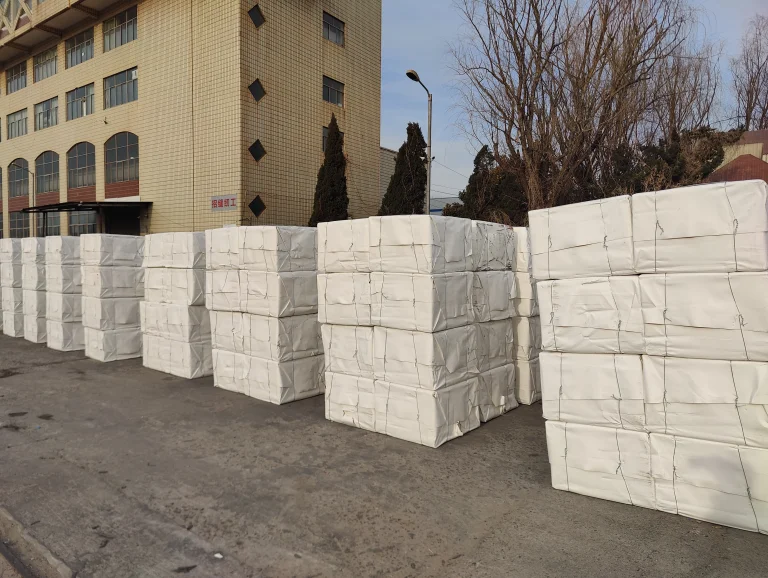
Bamboo paper is paper made wholly or partly from bamboo pulp, so buying it means choosing a pulp grade. Sheeon publishes bleached bamboo pulp at about 85% brightness with fibers longer than 1.7 mm, and unbleached at 40–43% brightness with fibers longer than 2.2 mm.

Bamboo paper is paper made wholly or partly from bamboo pulp, so buying it means choosing a pulp grade. Sheeon publishes bleached bamboo pulp at about 85% brightness with fibers longer than 1.7 mm, and unbleached at 40–43% brightness with fibers longer than 2.2 mm.